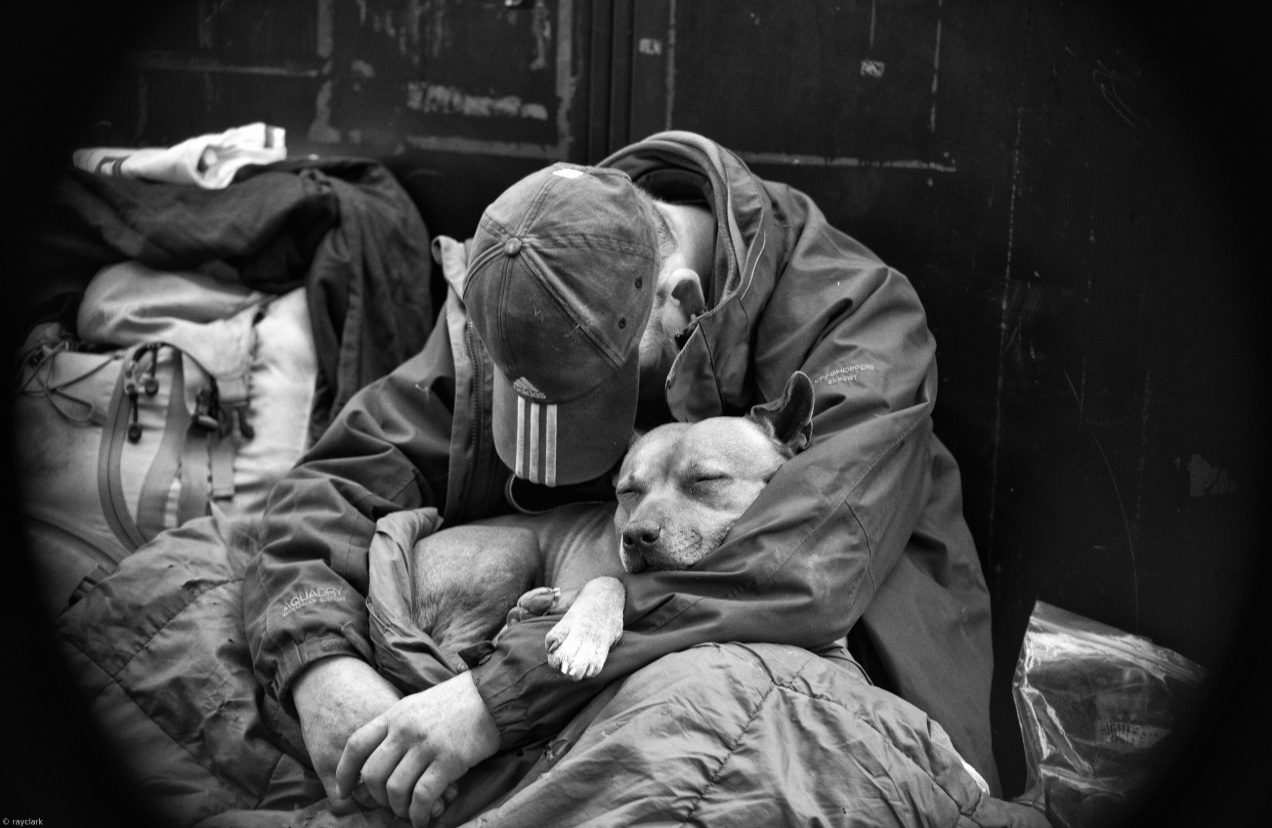
Certain phrases sound like the cold gleam of churches, Ricardo Navajo thought, as he stroked, lost to himself, the small dog at his side.
In this corner of the city, alms are, in a way, less miserly but far noisier. A man pressed to the ground hears everything, including words articulated with rote wisdom.
“We should feel grateful for what He has set aside for us and recognise that a crust of bread is as important as the beauty of the saxifrage.”
Whoever said it did so with a calm assurance that was at once the outward expression of a frantic search of the soul. Then, turning to his listeners in a kind of improvised sermon, he also said,
“Behold: there is a depth towards which the body weighs, and a whole sky towards which we must raise the soul. Beneath us the earth to cover us; above us the galaxies that shall guide our spirit for evermore.”
Ricardo Navajo scratched his chin with frozen fingers and long nails. Then he scratched his belly, unsettled by hunger. Next, he began to massage the nape of his mongrel companion, forgetting the plastic bowl where a few cents slept in peace.
At this corner of the city, people almost always walk in haste and almost never with pity. The conversations flung into the air are very much like fireworks: brief flares that glitter without warming.
The speaker has just gone into the Seminary with his disciples; cars blare their horns with steady ferocity; traffic lights open and close with the indifference of ancient gods.
Navajo has the habit of brooding on what others leave hanging as they pass by. Human thought, if there is any left, is organised like a structure of scaffolding. Each man sees the world in the way that suits him, supposing it to be unique and universal from the height, or the depth, of his own vantage point.
That there are beautiful flowers and stars around us, the beggar did not doubt. But a crust of bread and money so that the earth may receive our bones with dignity are another matter altogether.
Just now Navajo received the firm clink made by a one-euro coin. The Christmas season is a good harvest, he would reply, if anyone wished to know how life is going. He thanks it with a studied bow, while the palm of his hand runs along Riquinho’s back. That is the name of his best friend.

There was a time in Torben Bjørnsen’s life when his deeds flowed easily and applause reached him from every side. Success seemed without limit and he carried it in his gestures and in his words, for he was a fine writer and an even finer orator. The initials TB gleamed on bookish placards and university periodicals, but above all on the flyers and posters set at the entrances of the packed lecture theatres where he appeared so often.
But that was another time.
With no explanation we might offer the reader, Torben Bjørnsen flung himself into a harsh flight of self-erasure: he refused interviews, turned down invitations, forgot patrons and admirers, and sealed himself in a troubling muteness and solitude, as though he had suddenly needed to transform the empathetic skin of his former self into an armour of scales and spikes. For almost two decades he has produced no new writings, not even the brief prose poems we cherished so much.
Celebrity was followed by resentment and vendetta.
A kind of hatred for the man has taken root in Denmark, a country which, like all others, accumulates both noble and rotten makers of public opinion. Some claim Torben fled the reach of justice, guilty of some offence drawn from the spectrum of social aberrations. Others explain his silence through a profound religious conversion, the sort one does not expect in days so stripped of spirituality as ours. There are those, too, who justify the change with a single word: weariness.
Ida Kjær, a mutual friend, told us recently that she meets him once a year.
Torben does not live in Greenland, in the Faroe Islands, nor on any of those islets on the way to Sweden. He lives where he has always lived, with his cat, with his collection of nativity scenes, with his endless notebooks where he scrawls emendations and runic symbols. “Only older, much older, and filled with that childlike glow that draws us, on this Saint Lucy’s Day, in a crowd to the lighted canals. Torben will be there, anonymous and content, sharing and receiving lussebullar. You’ll see!”
The old man gathered every matchstick he could find. At first they took him for one of those model builders of castles and ships. But no one ever saw him create anything, not a single piece, and so, in time, they began to see him as a madman.
The small, burnt sticks give a beautiful sense of what our life is and what our death is. Some lose their heads easily, others keep their full ashen heads and charred bodies. When joined with patience and calm, they form palisades, bridges, rafts between the realm of the living and the realm of the dead. They resemble poems written to last a miraculous instant and a forever tinged with sorrow. One must understand them.
In December, when the days fade earlier, just before Christmas, they found the old man dead at home. He lay stretched on the floor, inside a gigantic cage made of thousands and thousands of those enchanting fragments of burnt wood. It was a poor mausoleum.
Whether it sheltered him or held him captive, no one has ever managed to understand from what, or why.
One of Herberto Helder’s most celebrated poems begins: “Amo devagar os amigos que são tristes com cinco dedos de cada lado” / “I love slowly the friends who are sad, with five fingers on each side” (“Aos Amigos,” Poemacto, 1961). Nothing gives itself to us—or gives us so deeply to others—as our hands do. The touch of hands trains our feelings, soothes the wretched, supports the powerless, opens places of refuge and hope to strangers and wanderers, draws in both the different and the familiar, seals pacts, builds bridges, and writes the essential words that the future will allow to take root.
On their skin, in the varied form of the fingers (as though the blessed difference of size and function made them inseparable creators of life), in the beauty of the nails, in the small blue threads of blood running to the tiniest venules and arterioles, in the lines where their phalanges bend and the full shell of their bones closes—there lies a science of fire.
By this science of fire I mean the gift we all possess (and so often refuse): the gift of loving, even in shadow, even in silence, on the humble scale of those who bring forth not injury but a poem, not hatred but friendship, not a hostile fist but an open and willing hand.
Herberto ends his poem with prophetic lines: “– Temos um talento doloroso e obscuro. / Construímos um lugar de silêncio. / De paixão.” / “– We have a painful and obscure talent. / We build a place of silence. / Of passion.” The world of men will only be saved when they understand what their hands are for—when they love the sad ones who keep them open, with five fingers on each side.
Suddenly I grasp the bestiality of humankind as I never had in nearly half a century of life. What is desecrated is the commonplace, the place of others, one’s own place. Each person becomes a latent enemy, a possible hatred, a quarrel, an insult, an act of aggression, a predatory gesture. I see how easily someone is wounded—without cause, without reason, without any concern for what each act is or signifies: a driver abandons his car to raise a violent arm against the one behind him; a ten-year-old hurls a death threat in class, at a fellow pupil or at the teacher; a patient dies on a hospital stretcher before the very eyes of the doctor meant to heal him; a president slanders and divides his people, scorning the oath sworn upon the Bible; a once-decimated nation commits mass murder, justifying force with the cowardly, hypocritical justice it claims to inherit. And suddenly I realize that the clear sun spilling across the windowsill and the blank page of my notebook is impure, unbearable.
I turn to Johann Sebastian Bach as a leper to his refuge. I turn to childhood, to the memory of good friends, of the idyllic walks to primary school, of the ancestral scent of herbs along the streams. I turn to the rigor of colors, the unequivocal weight of words, the care of nails, the truth in the eyes. Then, there was an immeasurable sense of hope. I learned to respect, to give thanks, to be gentle, to cultivate humor, to cherish the rare, beautiful objects given to me, to read books with delicate care, to press my spirit into the considered phrases I was asked to set down—one after another—in school compositions and in dialogue of subtlety. I turn to silence to remember all of this, to listen to the guitar suites, to step away from the noisy patina the days secrete.
The other day a student asked how I find inspiration. For an instant a banality hovered on my lips, a cliché, a ready-made reply. We were in a long room lined with state-of-the-art computers, breathing the air steeped in cables and devices. We were speaking of António Vieira, and of the courage to preach on the edge of the abyss. «I don’t know», «I never knew». That is the certainty. Inspiration—like opening one’s chest to the clean October air, brushing against dew, against the bright green of fennel and lemon verbena—I cannot explain it. Unless, perhaps, as a vast nostalgia, a melancholy urge to reinvent the days backwards, as when the pencil snapped along the nervous line and I thought «this is not the way». Suddenly humanity crumbles on the page, swollen with stupidity and perverse pride. And it is necessary that someone say «this is not the way».
Sophia de Mello Breyner Andresen photographed by Eduardo Gageiro
.
In one of the poems of No Tempo Dividido, Sophia de Mello Breyner Andresen writes, in the manner of an inscription: “Que no largo mar azul se perca o vento / E nossa seja a nossa própria imagem” — “That in the wide blue sea the wind be lost / And ours be our own image.”
The pelagic world was for the poet, as is commonly known, a demiurgic, almost religious space, from which emerged her creative force, her fascination with ancient time (which was equally her fascination with the inscrutable future), but also her most personal delight in the peoples who, having sailed those seas of a remote past (the Greeks, in particular), bequeathed to us their art, their beauty, their nude, and within them (as in Heidegger’s ontology) our destiny.
Sophia’s poems are, without exception, exercises in incomparable lapidary art. We read them today under the relative oblivion to which every work is consigned after the death of its author. Yet for this very reason we rediscover them as more vehement, more marvellously sculpted, more true. We read them as an extension of ourselves, as though seated on a garden bench among the twisted trunks of giant trees (like these metrosideros in Foz do Douro), the wide blue sea before us seemed more real, and our own spirit wandered amid those waves and the scent of the sea breeze, while between the seated body and the wandering spirit there existed something unnameable. Something like our own image, doubly beheld in the mirror.
João Ricardo Lopes în biroul său: fotografiat de Catarina Lopes (2025)
.
În decembrie 2024, un grup de poeți din peste douăzeci de țări europene și din câteva țări asiatice s-a reunit la București și a convenit asupra a ceva de neimaginat: crearea unei rețele informale de traducere, în afara institutelor naționale, a centrelor de difuzare, a mijloacelor de comunicare în masă, a revistelor și a marilor edituri. Scopul: a îndrepta atenția către acele unghere populate de autori marginali, puțin cunoscuți, excluși de forțele centrifuge ale curentului dominant, autori aflați în așteptarea unei șanse care, cel mai probabil, le va fi refuzată — dar care merită totuși acea privire străină ce adesea consfințește o operă, prin contrast cu nepăsarea cititorilor din limba lor maternă.
Poezia portugheză ne-a obișnuit de mult cu prezența unor nume mari, aflate sub tutela unor genii de talia lui Luís de Camões, Fernando Pessoa sau Sophia de Mello Breyner Andresen. În România, aceste nume sunt citite și studiate cu o anumită regularitate (în special Pessoa), alături de romancieri contemporani sau deja canonizați de tradiție: Eça de Queirós, Saramago, Agustina Bessa-Luís.
João Ricardo Lopes, colegul meu de Cultură Portugheză la Facultatea de Litere a Universității din Porto, pe vremea când am fost student Erasmus (în 1998), mi-a fost întotdeauna foarte drag. Azi profesor, ieri student, poet cu resurse literare inepuizabile, numără până în prezent șapte volume de poezie și două culegeri de proză (narațiuni scurte sub formă de povestiri și cronici).
Trăsături distinctive ale scrisului său: reconstrucția delicată a lumii în cuvinte atent cântărite, pline de vitalitate, lirism și ironie; plăcerea de a submina conceptele, pentru a chestiona paradigmele și valorile morale dominante; preferința pentru texte scurte și incisive, cu aluzii și subînțelesuri pe care cititorul este invitat să le descifreze; inserarea literaturii în alte arte, cu frecvente evocări de lucrări picturale, fotografice, cinematografice, muzicale sau sculpturale; o imprevizibilitate constantă în desfășurarea temelor, fie în incipit (mereu atent lucrat, chiar și atunci când pare lipsit de griji), fie în final (adesea abrupt, neașteptat, sarcastic, profund meditativ).
Cititorul român va recunoaște în această scriitură asemănări cu poetica lui Mihai Eminescu, Marin Sorescu sau Nicolae Diaconu, de exemplu.
•
ETICĂ
deschizi ferestrele sau ușa
și nu doar lumina pătrunde, ci și ciripitul păsărilor,
mirosul ploii, umezeala ierburilor.
e doar o zi obișnuită, o zi ca oricare alta,
ai dormit prost, e un obiect căzut
pe care îl pui la locul său
de aceea, ceva în tine e ancestral și puternic,
ieșit la iveală,
ca și cum ai fi atins adevărul
cu simplitatea unui proverb
Din volumul Em Nome da Luz (2022)
.
ÉTICA
abres as janelas ou a porta
e não é a luz só que entra, mas o trissar dos pássaros,
o cheiro da chuva, o húmido das ervas.
é um dia comum apenas, um dia como os outros,
dormiste mal, há um objeto caído
que devolves ao seu lugar
por isso, qualquer coisa em ti é ancestral e poderosa,
posta a nu,
como se tivesses atingido a verdade,
ou a fundura de um provérbio
De Em Nome da Luz (2022)
.
•
TOT CE ÎȚI TREBUIE SUNT DIMINEȚILE TRISTE
tot ce îți trebuie e o dimineață ca asta,
un pick-up vechi,
cutia cu discurile lui Jacques Brel, Léo Ferré,
Georges Brassens, Édith Piaf.
tot ce îți trebuie e să deschizi ferestrele
și să lași perdelele să fluture,
să treci din cameră în cameră prin casa goală
(în curând va veni soarele),
o aprindere în memorie,
să ai din nou optsprezece ani
(nu lăsa pe nimeni să-ți fure cei optsprezece ani),
să rămâi acolo mult timp
– în ceață, în uimire,
în fulgerarea diamantină care îți dă siguranța
că tot ce îți trebuie e un poem
și dimineți triste
Din volumul Em Nome da Luz (2022)
.
TUDO O QUE PRECISAS É DE MANHÃS TRISTES
tudo o que precisas é de uma manhã destas,
de um velho gira-discos,
do cartucho com os vinis de Jacques Brel, Léo Ferré,
Georges Brassens, Édith Piaf.
tudo o que precisas é de abrir as vidraças
e deixar que as cortinas esvoacem,
de ir de quarto em quarto pela casa vazia
(em breve o sol virá),
de um acendimento na memória,
de ter outra vez dezoito anos
(não deixes que te roubem os dezoito anos),
de permanecer aí muito tempo
– no nevoeiro, no alumbramento,
no fulgor adiamantino que te assegura
aquilo de que precisas é de um poema
e de manhãs tristes
De Em Nome da Luz (2022)
.
•
POETICĂ
cel mai mult îmi place
această lumină
dobândită,
așchiile albe ale vocii
printre hârtii,
furia vântului
printre rufele întinse,
memoria care înșiră
sâmbetele de demult
când frecam podeaua casei
cu săpun
și eram slujitori umili
ai unei cauze mai mari
și ne simțeam liniștiți
și curați înlăuntrul nostru
Din volumul Eutrapelia (2021)
.
POÉTICA
aquilo de que mais gosto
é desta luz
conquistada,
das brancas esquírolas da voz
entre os papéis,
da fúria do vento
pelo meio dos estendais,
da memória encordoando
os antigos sábados
em que esfregávamos o soalho da casa
com sabão
e éramos servos humildes
de uma causa maior
e nos sentíamos tranquilos
e asseados
De Eutrapelia (2021)
.
•
CREION HEMOSTATIC
mă văd bărbierindu-mi fața,
pielea primește mâna și-i oferă un loc în care să se miște.
ca marea, lama atinge toate părțile, dar niciodată prea mult,
apa spală pensula, prosopul șterge săpunul, oglinda corectează
și retușează
toate acestea, voi le știți
e ca și cum te-ai gândi la dasein-ul lui Heidegger fără să te gândești la Heidegger,
ca și cum ai privi fără să vezi ochii,
ca și cum ai strânge sângele într-un burduf fără să simți inima
voi știți
un bărbat se rade și nu înțelege nimic,
lucrurile se întâmplă și, întâmplate, bolborosesc în scurgere,
timpul se naște și merge spre îngropare
la sfârșit doar o mică incizie doare, ca și cum ar fi atinsă de boabe de sare.
când apăs creionul hemostatic pe rană,
degetele alunecă pe bărbie
și o piatră aproape moale răspunde:
fiule, sunt aici
(Poem inedit)
.
LÁPIS HEMOSTÁTICO
vejo-me a escanhoar o rosto,
a pele recebe a mão e oferece-lhe um lugar para movimentar-se.
como o mar a navalha toca todas as partes, mas não demais,
a água lava o pincel, a toalha limpa o sabão, o espelho corrige
e retoca
tudo isso, vós sabeis
é como pensar no dasein de Heidegger e não pensar em Heidegger,
é como olhar e não ver os olhos,
é como cingir o sangue num odre e não sentir o coração
vós sabeis
um homem barbeia-se e não percebe nada,
coisas acontecem e acontecidas gorgolejam no ralo,
o tempo nasce e vai a enterrar
no fim só uma pequena incisão dói como exposta a grãos de sal.
ao apertar o lápis hemostático contra a ferida
os dedos deslizam sobre o queixo
e é uma pedra quase macia quem responde
filho, estou aqui
(Poema inédito)
.
•
ALLEGRO
Ogni mattina il mio stelo vorrebbe levarsi nel vento soffiato ebrietudine di vita…
Alda Merini
.
de aici privesc zbuciumul măcălendrilor prin ramurile
lămâiului,
aud murmurul, ciripitul,
fluieratul turturelelor, rândunelelor, vrăbiilor,
fără să pot distinge în aer
începutul sau sfârșitul disputei lor
în mai diminețile
mă fac să mă cufund în pământ,
în abundența mirosurilor și formelor,
în prospețimea ierburilor,
în căldura garoafelor și a trandafirilor
mă înfior gândindu-mă că exist
și că respir
și că ascult timpul
departe, ca o umbră albastră a unui nume,
linia munților se clatină, tot mai estompată,
până când se pierde treptat
în interiorul propriei lumini
sau în penumbră
Din volumul Eutrapelia (2021)
.
ALLEGRO
Ogni mattina il mio stelo vorrebbe levarsi nel vento soffiato ebrietudine di vita…
Alda Merini
.
daqui observo o afã dos piscos nas ramagens
do limoeiro,
oiço o arrulhar, o trissar,
o assobiar das rolas, das andorinhas, dos pardais,
sem distinguir no espaço
o começo ou o fim da sua disputa
em maio as manhãs
fazem-me mergulhar na terra,
na profusão dos cheiros e das formas,
no frescor das ervas,
na quentura das cravinas e das rosas
arrepio-me de pensar que existo
e respiro
e escuto o tempo
ao longe, como a sombra azul de um nume,
a linha das montanhas oscila, cada vez mais difusa,
até perder-se aos poucos
no interior da própria luz
ou na penumbra
De Eutrapelia (2021)
.
•
CIREȘE
din acest fruct se extrage o amintire
de foc și de frig,
de cuvinte languide și suspine dolente
prin toată casa
bunica mea maternă alegea
cele mai rubinii și le mâncam cu mămăligă,
spunea că sângele cireșelor vindecă durerea bătrânilor
și inoculează tinerilor tristețea,
fiindcă pulpa lor e nesigură
când vine vorba de socotelile iubirii
n-am știut niciodată să iubesc cireșele.
sunt ca superstițiile
pentru care nu există descântec
văd păsările năvălind în pomi
și luându-le grăbite în zbor.
o fi ceva de suflete,
nu le invidiez bucuria
sângele ce le pătează ciocul
mi se pare un semn rău:
știu – nu știu cum, dar știu –
că în curând vor muri
(Poem Inedit)
.
CEREJAS
desse fruto extrai-se uma memória
de fogo e de frio,
de palavras lânguidas e dolentes suspiros
através da casa
a minha avó materna escolhia
as mais rubicundas e comi-as com broa,
dizia o sangue das cerejas cura a dor dos velhos
e inocula nos jovens a tristeza,
porque a sua carne é incerta
às contas do amor
eu nunca soube gostar das cerejas.
é como as superstições para as quais
não existe esconjuro
vejo os pássaros a assaltar as árvores
e a levá-las à pressa no ar.
será uma coisa de almas,
não lhes invejo o gáudio
o sangue que lhes tinge o bico
parece-me mau presságio:
sei – não sei como, mas sei –
que em breve morrerão
(Poema inédito)
.
•
SOARELE GUTUIULUI, VÍCTOR ERICE (1992)
Antonio López García căuta lumina exactă
cu care se limpezește privirea.
munca pictorului e asta,
să ajungă fără ocolișuri la plinătatea fructului,
să o atingă în plin,
ca o lamă în miezul cărnii
Din volumul Eutrapelia (2021)
.
O SOL DO MARMELO, VÍCTOR ERICE (1992)
Antonio López García procurava a luz exata
com que se apura o olhar.
o trabalho do pintor é esse,
atingir sem rodeios a plenitude do fruto,
atingi-lo em cheio,
como uma lâmina sobre o miolo da carne
De Eutrapelia (2021)
.
•
AUGUST
su frágil armazón de inseguros instantes
José Luis García Martín
.
ar trebui să-ți vorbesc despre sidef,
despre cum toate trupurile irizate sunt frumoase,
fără să uit chitina cărăbușului
sau pata de combustibil
ar trebui să-ți spun cât de mult mă intriga
formele interioare ale cuarțului,
ale sării, ale bilelor de sticlă
sau acest verde-albastru al mării
care mă rănește ca o crisocolă între degete,
acest albastru în care ochii adorm
și, nesiguri, îngheață în tăcere
acest punct exact
în care infinitezimalul și infinitul segregă clipa
și se solidifică în sticlă
Din volumul Eutrapelia (2021)
.
AGOSTO
su frágil armazón de inseguros instantes
José Luis García Martín
.
deveria falar-te do nácar,
de como são belos todos os corpos iridescentes,
sem esquecer a quitina do escaravelho,
ou a mancha de combustível
deveria contar-te o quanto me intrigam
as formas interiores do quartzo,
do sal, dos berlindes
ou este verde azul do mar
ferindo-me como crisocola entre os dedos,
este azul onde os olhos adormecem
e indecisos gelam em silêncio
este ponto exato
em que o ínfimo e o infinito segregam o instante
e em vidro solidificam
De Eutrapelia (2021)
.
•
PETRICOR
o lună întreagă soarele a pârjolit
pământul
și încă o lună, și încă una.
pietrele se spărgeau ziua
și noaptea beau
roua – bieți
stropi uscați de ființă.
în a patra lună
norii au adus pânza lor de tifon,
păsările țopăiau nebune,
mirosul pământului ud – o imensă
supă minerală –
invada casele, paturile,
ochii uscați.
în tăcere au fiert lacrimile,
pământul găsise în sfârșit
o cale de a se ierta
Din volumul Em Nome da Luz (2022)
.
PETRICOR
um mês inteiro o sol massacrou
a terra
e outro mês e outro.
as pedras quebravam durante o dia
e à noite bebiam
o orvalho – pobres
criaturas esturricadas.
no quarto mês
as nuvens trouxeram a sua gaze,
os pássaros pulavam como doidos,
o cheiro da terra molhada – imensa
sopa mineral –
invadiu as casas, as camas,
os olhos ressequidos.
em silêncio borbulharam lágrimas,
a terra descobrira por fim
um modo de se perdoar
De Em Nome da Luz (2022)
.
•
LA CINCIZECI
la cincizeci nu mai confunzi valoarea unui poem,
sau iubirea unei femei.
la cincizeci, în lucrurile pe care le facem
domnește lumina fixă a unei lămpi
impunem reguli:
să ascultăm în mașină Mingus, Davis, Coltrane,
să citim doar de la Borges în sus,
să mergem,
să alegem bine dușmanii, să uităm mediocrii,
să ascultăm stomatologul, să promitem familiei,
să hrănim speranța
la cincizeci lumina nu ascunde, nu dezvăluie,
este doar un loc în care mergi
când niciun alt loc nu te mai poate primi –
locuim în ore, căci și timpul
e un loc în care ne lăsăm trupul
la cincizeci ajunge uneori un singur vers.
aproape întotdeauna el este cel care ne salvează
Din volumul Em Nome da Luz (2022)
.
AOS CINQUENTA
aos cinquenta já não se confunde a qualidade de um poema,
ou o amor de uma mulher.
aos cinquenta impera nas coisas que fazemos
a luz fixa de uma lâmpada
impomos regras:
ouvir no carro Mingus, Davis, Coltrane,
ler somente de Borges para cima,
ir,
escolher bem os inimigos, esquecer os medíocres,
ouvir o dentista, prometer à família,
acalentar a esperança
aos cinquenta a luz não tapa nem destapa,
é somente um lugar aonde se vai
quando nenhum sítio é capaz
– moramos nas horas, porque também o tempo
é um lugar onde deixamos o corpo
aos cinquenta um só verso às vezes basta.
quase sempre é ele que nos salva
De Em Nome da Luz (2022)
.
•
MĂSLINUL DIN LANZAROTE
în lucrurile vechi
există certitudinea adâncă că viața
nu dă greș
în legământul ei cu moartea
mă gândesc la măslinul din Lanzarote,
la cel pe care Saramago a cerut să-l aducă,
și care, într-o zi,
printre lavă neagră și pulbere pozolanică,
va purta pielea unei țestoase de-un veac
și mlădițe încolăcindu-i trunchiul,
acum tânăr
și trufaș
Din volumul Em Nome da Luz (2022)
.
A OLIVEIRA DE LANZAROTE
existe nas coisas velhas
a certeza inexorável de que a vida
não falha
no seu pacto com a morte
penso na oliveira de Lanzarote,
na que Saramago mandou trazer
e que também um dia,
entre lava negra e pozolana,
terá uma pele de tartaruga centenária
e vergônteas torcendo-lhe o tronco,
agora jovem
e arrogante
De Eutrapelia (2021)
.
•
ZGOMOT
Because I do not hope to turn again
T. S. Eliot
.
tot ce-am spus, n-am spus.
lumini negricioase hrănind ochii
ca și cum prea devreme ar fi deja prea târziu.
un geam înclină peste noi
pleoapa-i aspră și tăcută.
să fi meritat. totul
Din volumul Reflexões à Boca de Cena / Onstage Reflections (2011)
.
RUÍDO
Because I do not hope to turn again
T. S. Eliot
.
tudo o que disse não disse.
luzes negrentas cevando os olhos
como se cedo fosse já tão tarde.
uma janela declina sobre nós
a pálpebra rude e silenciosa.
que tenha valido a pena. tudo
De Reflexões à Boca de Cena / Onstage Reflections (2011)
.
•
CITIT PE PIETRELE VECHIULUI CIMITIR
I am afoot with my vision
Walt Whitman
.
le citesc numele, amintirea, piatra spălată,
vagi sinopsisuri gravate pe dos,
mușchi verde intens între datele cronologice.
o mare tăcere ne mătură mâinile — pare
o minciună — o mare tăcere fără explicație,
o mare tăcere de păsări și var.
ies și scutur umerii, mă opresc în fapte
banale, un pahar de țuică, același cântec
roade al crâșmei, umflarea acordeonului până
la tremurul înalt al ulmilor.
le citesc fostele chipuri de oameni, forma
exactă a ruinei, ani scriși pe dos.
și atunci da, dorul apasă, strivește —
mușchi verde intens, am zis, ce ne mănâncă numele,
că viața e asta. o viață zgârcită
Din volumul Reflexões à Boca de Cena / Onstage Reflections (2011)
.
LIDO NAS PEDRAS DO VELHO CEMITÉRIO
I am afoot with my vision
Walt Whitman
.
leio-lhes o nome, a memória, a laje lavada,
vagas sinopses grafadas de trás para a frente,
musgo verdíssimo no meio da cronologia.
um grande silêncio varre-nos as mãos — parece
mentira — um grande silêncio de coisa sem
explicação, um grande silêncio de pássaros e cal.
saio e sacudo os ombros, detenho-me em factos
comuns, um copo de aguardente, o mesmo canto
carcomido da taberna, o inchar do acordeão até
ao alto tremeluzir dos ulmeiros.
leio-lhes o outrora semblante de gente, a forma
exacta da ruína, anos escritos de trás para a frente.
e então sim apertam as saudades, esmagam —
musgo verdíssimo, disse, comendo-nos o nome,
que a vida é isto. uma unhas-de-fome
De Reflexões à Boca de Cena / Onstage Reflections (2011)
.
•
CURRICULUM VITAE
a fost cel mai josnic
om pe care l-am cunoscut
a respins toate sfaturile
a băut peste măsură
a distrus orice urmă de lacrimi curate
n-a vrut niciodată să știe
de iubirea care se dă
sau se primește
aproape niciun prieten
n-a avut
ultimele lui cuvinte
au fost:
„nu poseda, nu ezita,
doar mergi”
Din volumul Dias Desiguais (2005)
.
CURRICULUM VITAE
foi o homem mais perverso
que conheci
ignorou todos os conselhos
bebeu de mais
arruinou lágrimas puras
nunca quis saber
do amor capaz de ser dado
ou recebido
quase nenhuns os amigos
que fez
as suas últimas palavras
foram:
«não possuas, não hesites
caminha apenas»
De Dias Desiguais (2005)
.
•
FOARTE SCURT
pe străzile acelea, tot mai adânc,
numai poezia ne spune cine suntem
Din volumul Dias Desiguais (2005)
.
BREVÍSSIMO
por essas ruas até mais para dentro
apenas a poesia nos diz quem somos
De Dias Desiguais (2005)
.
•
IMPROPTUS D. 899 / OPUS 90, SCHUBERT
încet, spațiul îmbrățișează frigul,
bătătura udă,
potecile pline de noroi,
fumul care se îngroașă peste câmpuri
în mâini, un creion ascuțit,
ritmul lui Schubert,
nașterea austeră a unui poem nou
el e cel care te încălzește – mereu a fost
Din volumul Em Nome da Luz (2022)
.
IMPROPTUS D. 899/ OPUS 90, SCHUBERT
lentamente o espaço acolhe o frio,
a eira molhada,
os caminhos repletos de lama,
o fumo engrossando nos campos
tens nas mãos um lápis afiado,
o ritmo de Schubert,
o parto rigoroso de um poema novo
é ele que te aquece – sempre foi
De Em Nome da Luz (2022)
.
•
Notă biografică, selecție de poeme și traducere realizate de Ileana Ardeleanu.